
Moving from “Frankenstein” Infrastructure to a Unified Private Cloud
The Modern Enterprise Bottleneck
For most established enterprises, the problem isn’t “speed” in the startup sense. It’s complexity.
Years of growth have left IT teams managing a “Frankenstein” platform: a patchwork of siloed tools, mismatched versions, and manual processes.1 Infrastructure has become a series of tickets, and upgrades are high-stakes weekend “bridge calls” that everyone dreads.
VMware Cloud Foundation (VCF) 9 is the exit ramp from this cycle.
At CloudBunch, we see VCF 9 as more than an update. It is a strategic consolidation. It’s about taking the existing VMware footprint you’ve spent years building and turning it into a modern, unified platform that finally behaves like the cloud.
The End of Tool Fatigue: A Unified Interface
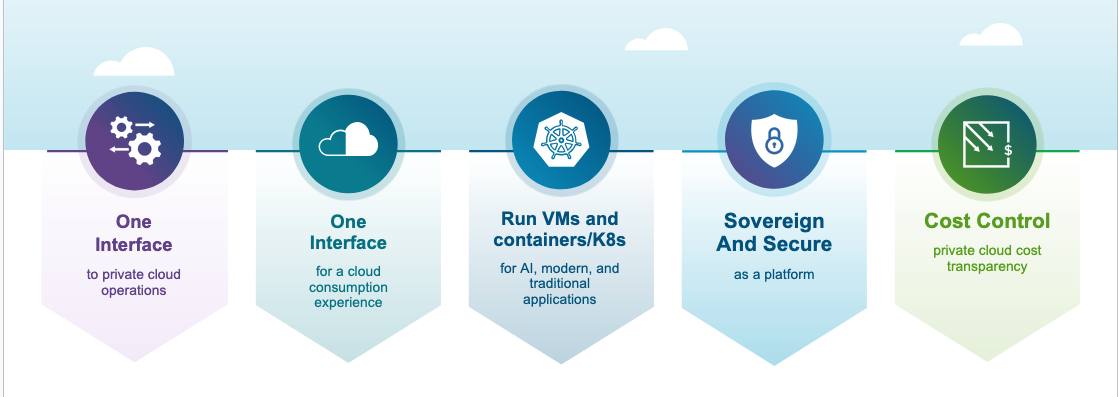
The most significant shift in VCF 9 is operational. VMware has finally moved away from fragmented management consoles to a cohesive “Product” experience.2
- VCF Operations: This is now the “Front Door.” It is the primary interface for platform admins to monitor health, manage capacity, and optimise performance.3
- SDDC Manager: Now functions as the “Engine Room.” It stays under the bonnet, silently handling the heavy lifting of lifecycle management (LCM), security certificates, and fleet-level patching.4
- VCF Installer: The “Onboarding Wizard.” Whether you are deploying from scratch or importing an existing vSphere environment, this single OVA handles the setup, significantly reducing the “Day 0” risk.5
| Feature | The Siloed Enterprise (Old Way) | The VCF 9 Platform (New Way) |
| Primary Interface | 5+ disjointed portals | VCF Operations (The Hub) |
| Upgrade Experience | Manual, multi-step checklists | Automated Lifecycle (The Engine) |
| Resource Efficiency | Siloed clusters with low density | Global Dedupe & NVMe Tiering |
| Delivery Model | Ticket-based requests | Self-Service IaaS APIs |
Why the Shift to “Operations-First” Matters
Why the Shift to “Operations-First” Matters
In previous versions, administrators spent a disproportionate amount of time in SDDC Manager just to keep the lights on. In VCF 9, the complexity of the underlying stack is abstracted away.
By centralising management in VCF Operations, teams gain Cloud Cost Transparency. You can finally see the true Total Cost of Ownership (TCO) across your hardware, licensing, and power consumption—all from one dashboard.
CloudBunch Perspective: We don’t just “patch” systems; we stabilise platforms. VCF 9 allows us to help enterprise teams shift their focus from fixing infrastructure to optimising the service they provide to the business.
The Three Paths to Modernisation
Every enterprise starting point is different. We focus on three distinct transition strategies:
1. The “Modernise in Place” Strategy (Brownfield) For organisations already running VCF, this is about simplifying the experience. We help move your daily operations into the new unified consoles, unlocking fleet-level management and better security visibility without re-architecting the whole stack.
2. The “Converged Migration” Strategy (Traditional vSphere) For teams stuck on traditional vSphere/vCenter silos. We use the VCF Import capabilities to bring existing workloads into the VCF 9 fold, replacing manual toil with automated lifecycle management.
3. The “Hardware Refresh” Strategy (Greenfield) The ideal path during a data centre refresh. Leveraging VCF 9’s vSAN ESA Global Deduplication, we can significantly reduce the physical hardware footprint—often lowering power and cooling costs by 25–30%.
Why Now? The Strategic Reality
With the recent changes in the Broadcom era, the cost of “doing nothing” has increased. Siloed, under-utilised infrastructure is now a financial liability.
VCF 9 is designed for the enterprise that needs to:
- Consolidate: Do more with fewer servers through better VM density.
- Standardise: Use the same operating model across the data centre and the edge.
- Innovate: Support Private AI and Kubernetes as native features, not complex side-projects.
The Takeaway
Infrastructure shouldn’t be a project you “manage”; it should be a service you “consume.” VCF 9 is the tool that finally makes that possible for the enterprise.
At CloudBunch, we help enterprise teams navigate this transition. From designing the migration roadmap to automating the final hand-over, we ensure your move to VCF 9 is a strategic win, not just a technical update.