
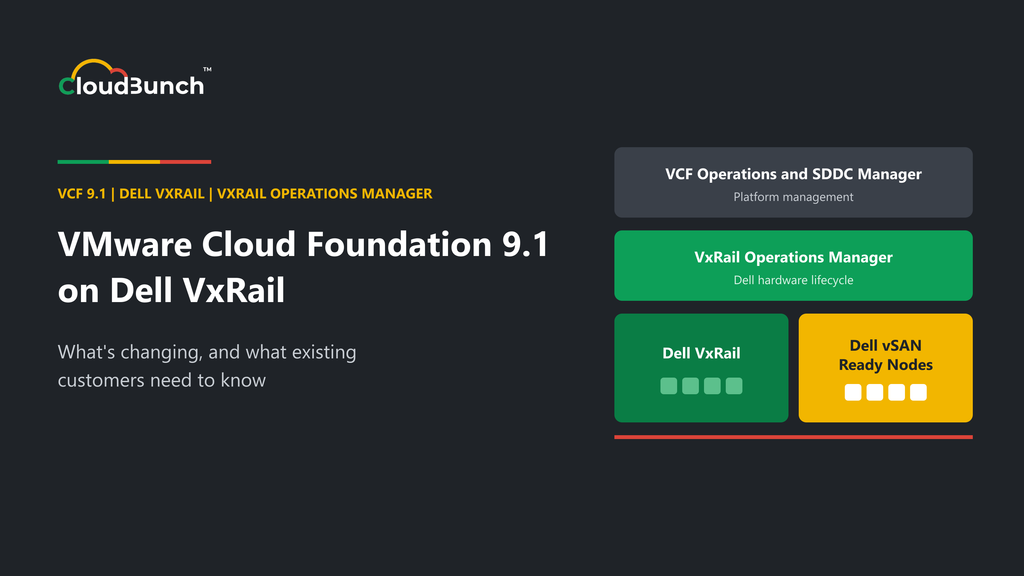
VMware Cloud Foundation 9.1 on Dell VxRail: What’s Changing and What Existing Customers Need to Know
VMware Cloud Foundation | Dell VxRail | VCF 9.1 | VxRail Operations Manager (VOM)
VMware Cloud Foundation (VCF) 9.1 introduces an important evolution in how organisations deploy, manage and scale their private cloud infrastructure on Dell VxRail.
The latest release brings a more consistent management experience across supported hardware platforms, introduces greater flexibility when deploying workload domains and provides an in-place upgrade path for existing VxRail customers.
For organisations already running VMware Cloud Foundation on Dell VxRail, this is an important development. It provides an opportunity to move towards the latest VCF architecture while retaining the benefits of Dell’s integrated and validated infrastructure platform.
In this article, we look at the key changes introduced with VCF 9.1, the new VxRail Operations Manager (VOM), the upgrade considerations for existing customers and what mixed hardware support means for future infrastructure deployments.
1. A New Direction for VMware Cloud Foundation on VxRail
Historically, VMware Cloud Foundation deployments followed a relatively strict hardware model. Organisations typically deployed either Dell VxRail clusters or vSAN Ready Nodes within their environments.
While this provided a consistent and validated infrastructure platform, it could introduce limitations when organisations wanted to expand their private cloud using different hardware configurations.
VCF 9.1 introduces greater flexibility.
The platform now provides a more consistent deployment and management experience across supported hardware platforms, while maintaining Dell’s engineering, validation and support model for VxRail customers.
This is an important distinction. Although the underlying VCF platform is becoming more standardised, VxRail remains a Dell-engineered and Dell-supported solution.
2. Introducing VxRail Operations Manager (VOM)
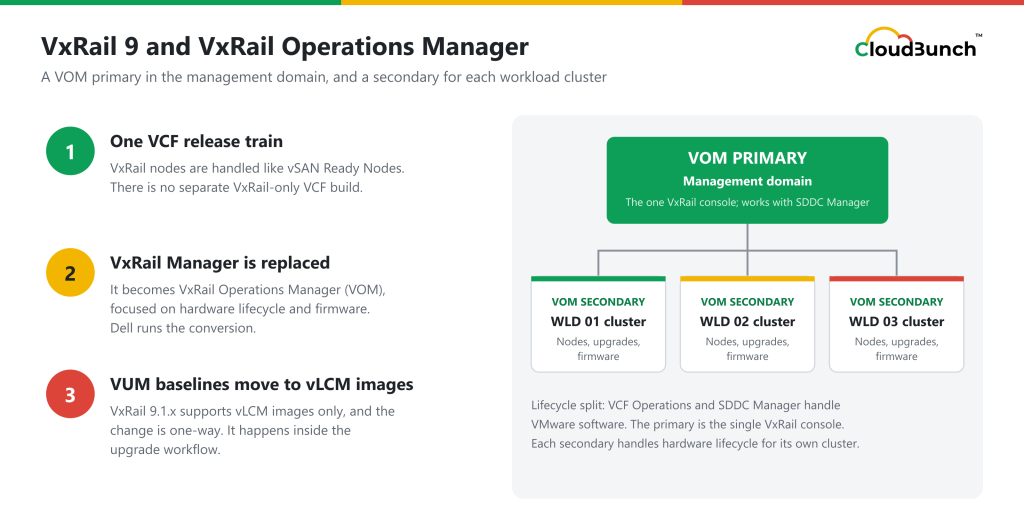
One of the terminology changes to understand when moving towards the VCF 9 architecture is the introduction of VxRail Operations Manager (VOM).
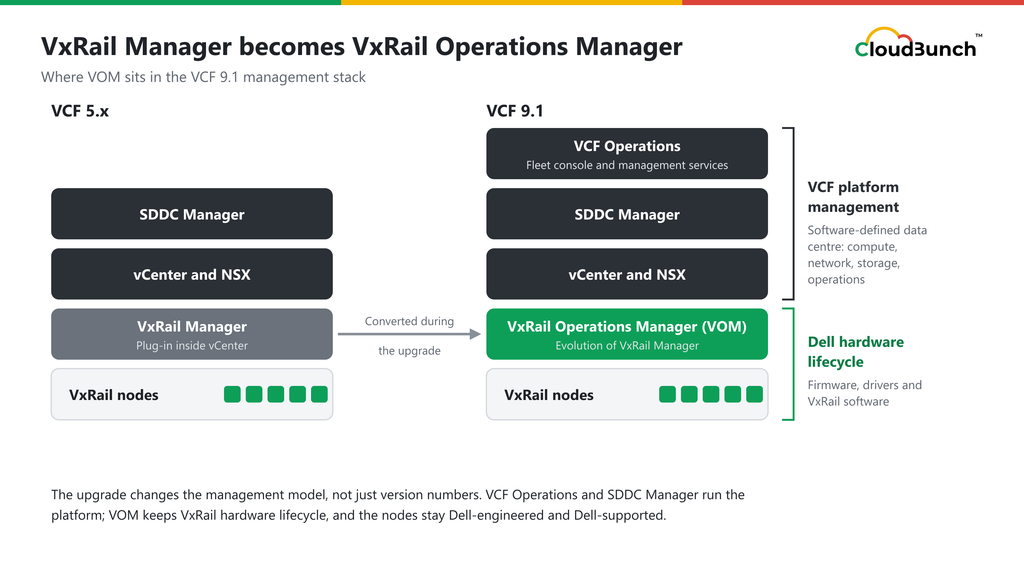
Previously, VxRail Manager provided the management and lifecycle capabilities associated with Dell VxRail clusters.
With the new architecture, VxRail Operations Manager represents the evolution of this management component.
For existing VxRail customers, this is an important part of understanding the transition to VCF 9.1.
The management architecture evolves alongside VMware Cloud Foundation, with clearer separation between the management of the overall software-defined data centre and Dell-specific hardware lifecycle operations.
Rather than viewing this as simply a software version upgrade, customers should understand that the transition also involves changes to the underlying management and operational model.
This is particularly relevant when planning upgrades from existing VCF 5.x environments.
3. Upgrade Path for Existing Dell VxRail Customers
One of the most important announcements for existing VxRail customers is the availability of a supported upgrade path to VMware Cloud Foundation 9.1.
VMware and Dell have collaborated to provide an in-place upgrade approach, allowing eligible customers to transition their existing infrastructure without having to wipe and reimage their VxRail hosts.
Before starting the upgrade, environments must meet the minimum version requirements:
VMware Cloud Foundation 5.2.2 or later.
Dell VxRail 8.0.361 or later.
This provides a clear starting point for organisations planning their transition.
However, not every deployment configuration is supported in the initial VCF 9.1 upgrade path.
Customers running the following configurations will need to wait for a subsequent release with an appropriate supported upgrade path:
Stretched clusters.
Dynamic Nodes.
Two-node deployments.
Satellite Node deployments.
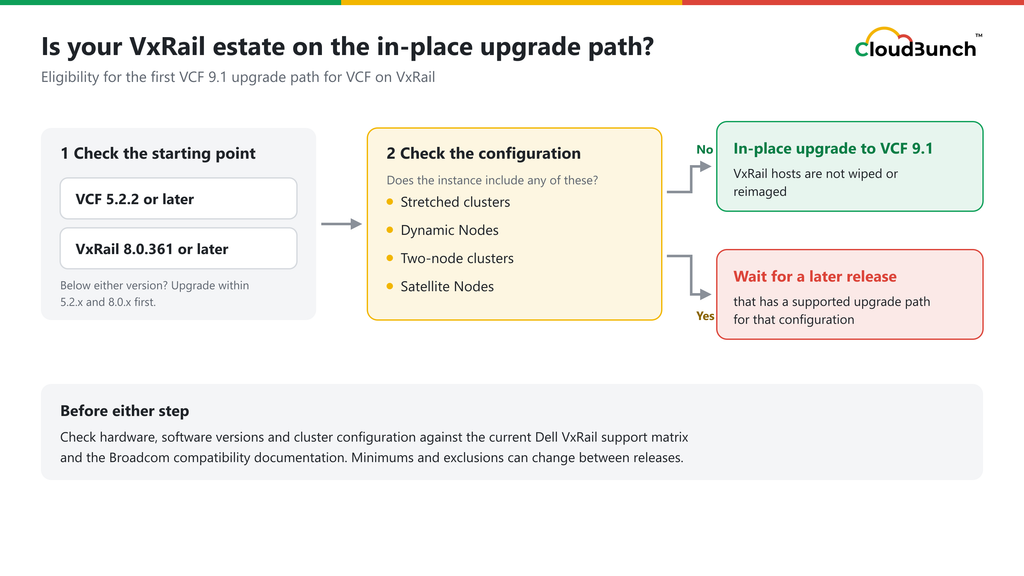
As with any major infrastructure upgrade, organisations should validate their existing configuration against the latest Dell and Broadcom compatibility and support documentation before proceeding.
4. Mixed Hardware Support: Greater Infrastructure Flexibility
Another significant enhancement in VCF 9.1 is the ability to introduce mixed hardware within the same VCF deployment.
Previously, customers generally had to maintain a consistent hardware platform across their VCF environment.
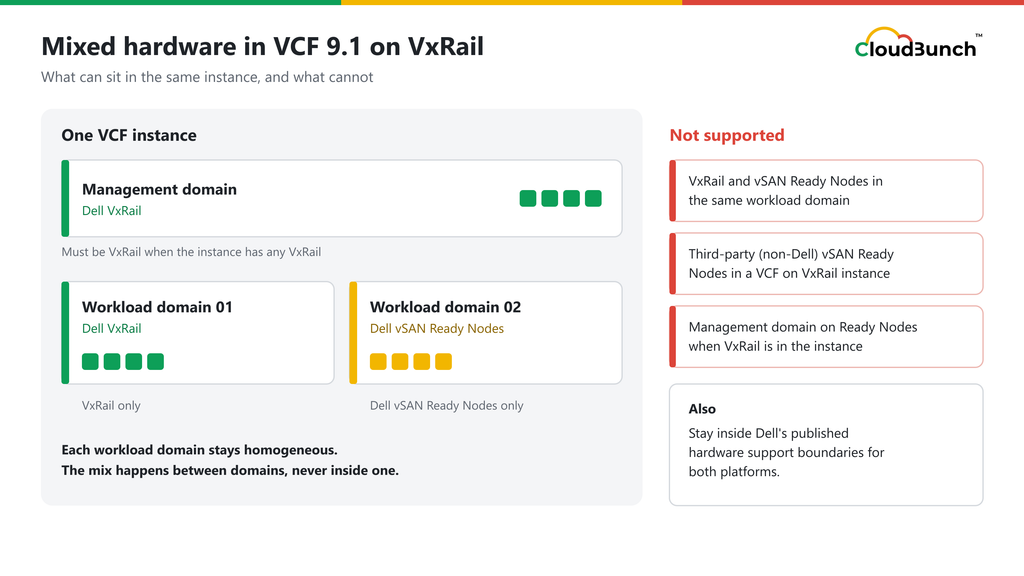
VCF 9.1 introduces the ability to combine:
Dell VxRail clusters: Providing an integrated hyperconverged infrastructure platform with Dell-managed lifecycle capabilities.
Dell vSAN Ready Node clusters: Providing certified hardware with greater flexibility around hardware selection and procurement.
This opens up additional possibilities for organisations expanding their private cloud environments.
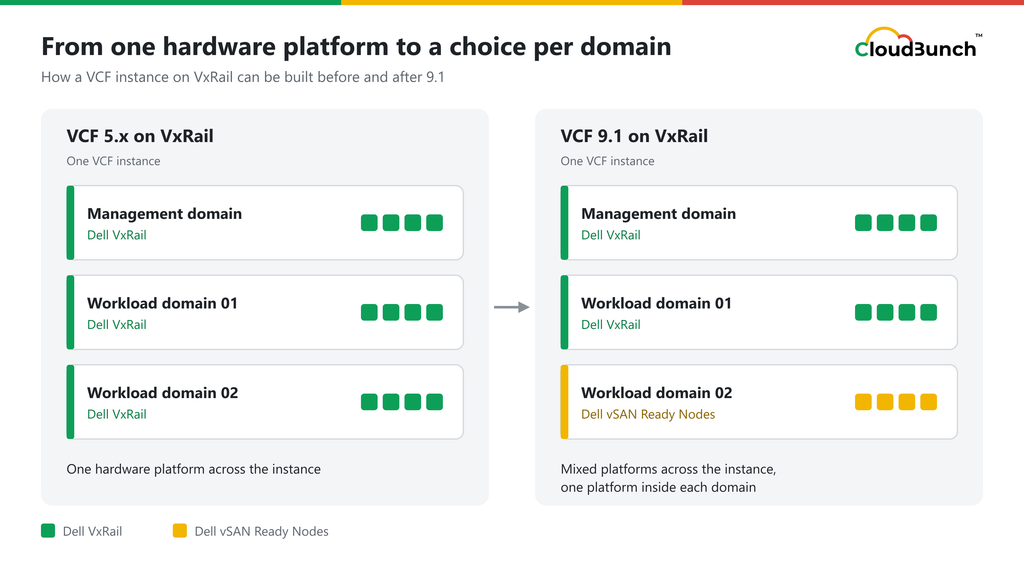
For example, an organisation running an existing VCF on VxRail management domain could introduce a new workload domain using Dell vSAN Ready Nodes, subject to the supported configuration requirements.
There are, however, some important restrictions:
Each individual workload domain must remain homogeneous. A workload domain must use either VxRail or Dell vSAN Ready Nodes.
Third-party vSAN Ready Nodes are not supported within VCF on VxRail instances.
Where VxRail is present in the VCF instance, the management domain must remain VxRail-based.
Dell’s defined hardware support boundaries must be followed.
This provides greater flexibility without compromising the validated infrastructure and support model.
5. Unified Operations and Lifecycle Management
VCF 9.1 continues to develop the unified management experience across the private cloud environment.
VCF Operations and SDDC Manager work together to provide visibility, orchestration and lifecycle management across the infrastructure.
The platform recognises that different cluster types have different lifecycle requirements.
For example:
VxRail clusters continue to use Dell’s integrated VxRail lifecycle management capabilities.
Dell vSAN Ready Node clusters follow the standard VCF lifecycle management process.
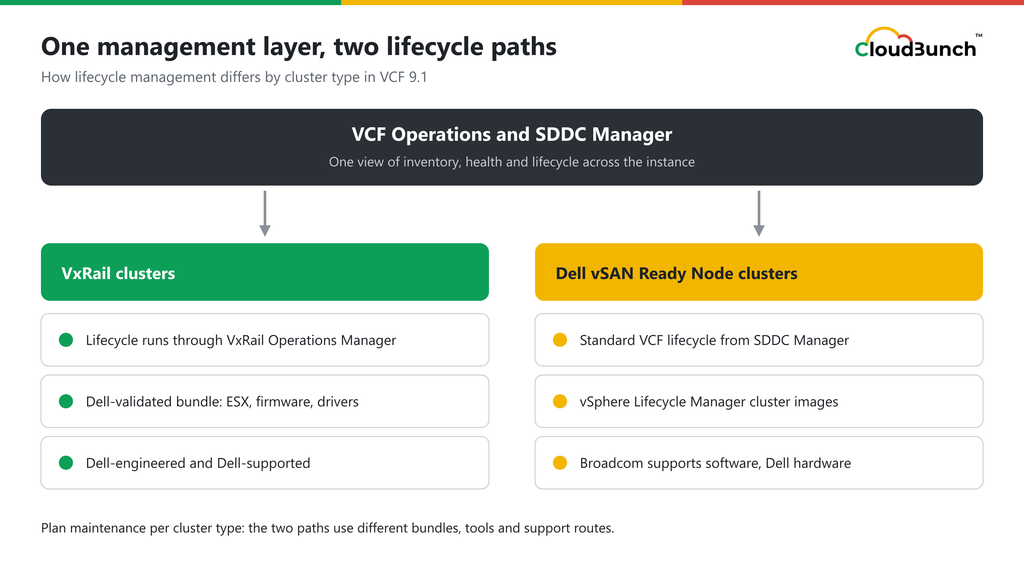
This approach allows organisations to benefit from a consistent overall management experience while retaining the specific lifecycle capabilities associated with each hardware platform.
For infrastructure teams, this means greater flexibility when planning capacity expansion, introducing new workload domains and evolving existing private cloud environments.
6. What Should Existing VxRail Customers Consider?
For organisations currently running VMware Cloud Foundation on Dell VxRail, VCF 9.1 represents an important step forward.
However, moving to the new architecture requires proper planning.
Before considering an upgrade, infrastructure teams should review the following areas:
Infrastructure compatibility
Review existing VxRail hardware, software versions and cluster configurations against the supported VCF 9.1 compatibility requirements.
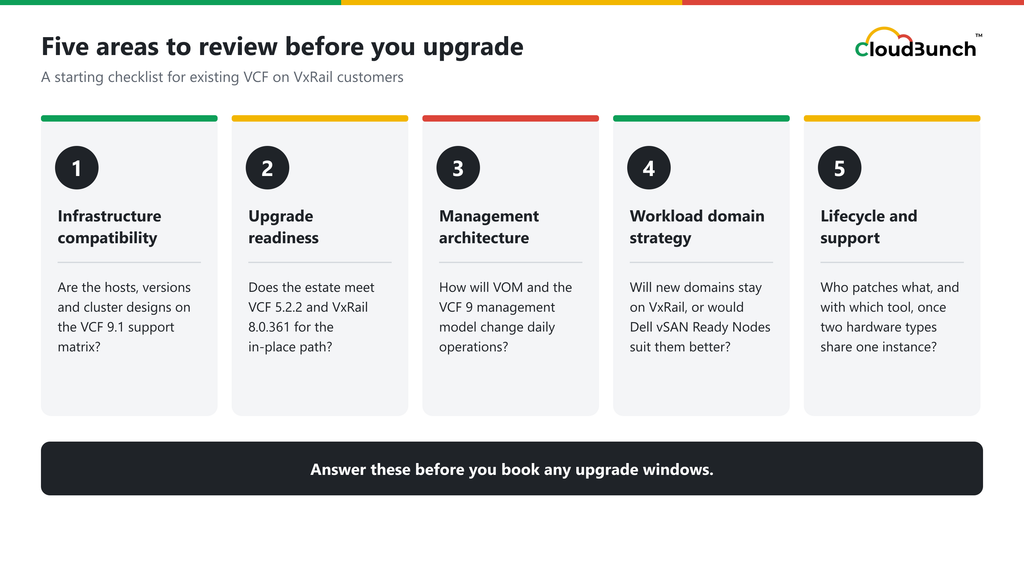
Upgrade readiness
Confirm that the existing environment meets the minimum software and VxRail version requirements for the in-place upgrade path.
Management architecture
Understand the changes associated with VxRail Operations Manager (VOM) and how the new management model fits into the wider VCF architecture.
Workload domain strategy
Consider whether future workload domains will continue using VxRail or whether Dell vSAN Ready Nodes could provide additional flexibility.
Lifecycle and support
Review the differences between VxRail lifecycle management and standard VCF lifecycle management, particularly when operating a mixed hardware environment.
Taking the time to assess these areas will help organisations establish a clear upgrade and infrastructure modernisation strategy.
7. Final Thoughts
VMware Cloud Foundation 9.1 represents an important development for Dell VxRail customers.
The introduction of VxRail Operations Manager, the supported in-place upgrade path and the ability to deploy mixed hardware workload domains provide organisations with greater flexibility when planning their private cloud strategy.
For existing VxRail customers, the move to VCF 9.1 is not simply about upgrading to a newer version. It is about understanding the evolving management architecture and taking advantage of the new capabilities available across the platform.
For infrastructure architects and VMware administrators, now is a good time to review existing VCF environments, assess hardware compatibility and start planning the transition.
How CloudBunch Can Help
At CloudBunch, we help organisations assess, modernise and transform their VMware infrastructure.
Our VMware Cloud Foundation services include:
VCF Readiness Assessments.
VCF architecture and design.
VCF upgrades and lifecycle management.
Dell VxRail infrastructure assessments.
Private cloud modernisation and migration planning.
Whether you are preparing for VCF 9.1 or evaluating your existing VxRail environment, we can help you understand the technical requirements and develop a structured approach to your next infrastructure upgrade.
Planning your next VMware Cloud Foundation upgrade?
Visit CloudBunch to find out how we can help.
References
-
- VMware Cloud Foundation Blog: VMware Cloud Foundation 9.1 – Path for Dell VxRail Customers – Tony Huynh, 16 June 2026.
-
- Dell Technologies: VMware Cloud Foundation on VxRail Architecture Guide.
-
- Dell Technologies: VMware Cloud Foundation 9.x on Dell VxRail 9.x Support Matrix.